

Soft-Tissue Injury Care After an Auto Accident in Cedar Park
Get gentle, auto-injury focused chiropractic care for sprains, strains, muscle tears & $0 out-of-pocket care in most cases.
Soft-tissue injuries are the most common—and most overlooked—injuries after an auto accident. Whether you’re dealing with muscle soreness, ligament sprains, or deep tissue pain that gets worse days after the crash, our clinic provides specialized soft tissue injury treatment in Cedar Park with $0 out-of-pocket in most cases. We work directly with attorneys and auto insurance to document your injuries and ensure you receive the care your case requires.
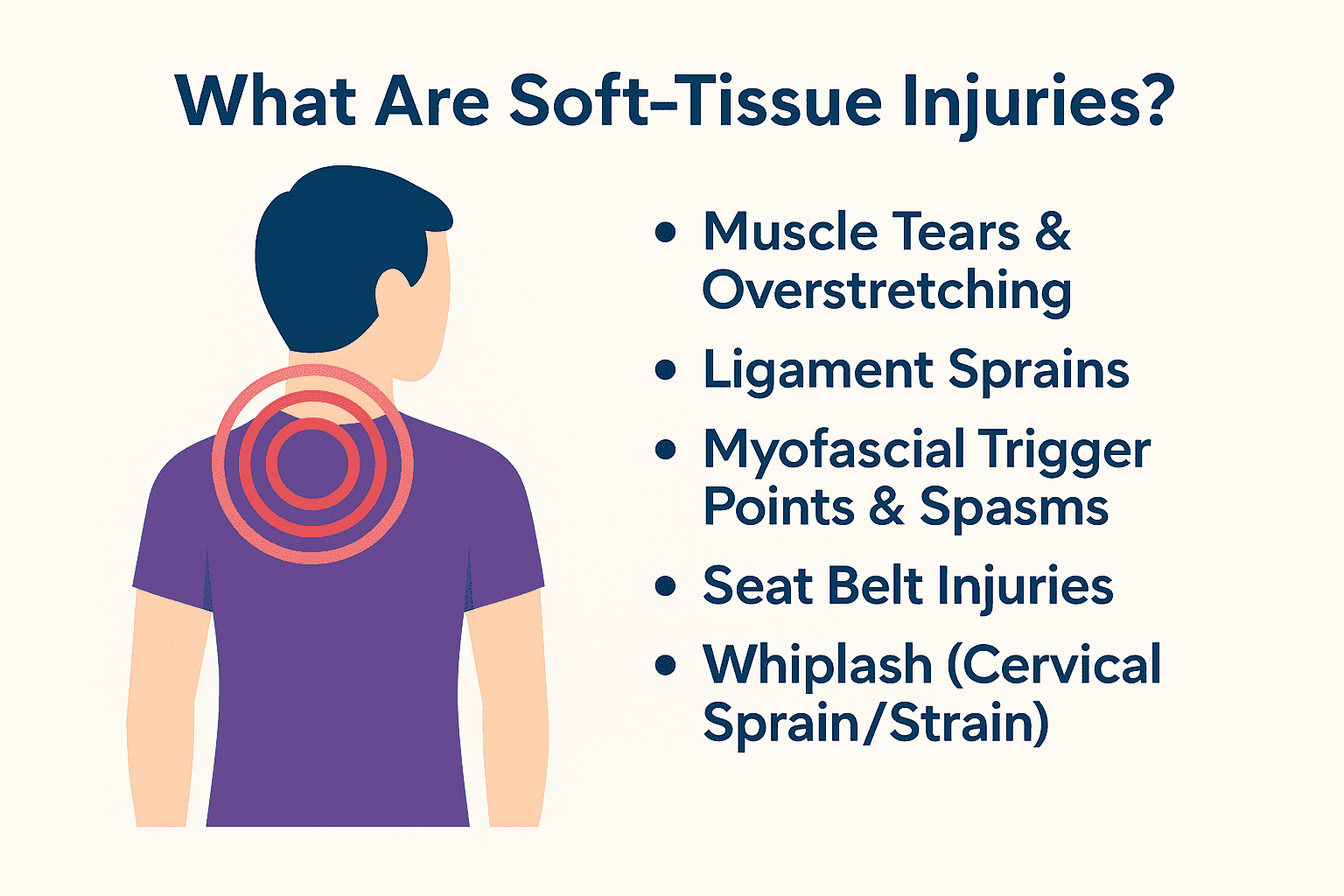
What Are Soft-Tissue Injuries?
Understanding the Most Common Auto Accident Injury
Soft-tissue injuries affect the muscles, tendons, and ligaments. These injuries don’t show up on standard imaging like X-rays, which is why they are often missed by ER visits or urgent care.
Common soft-tissue injuries after a motor vehicle accident include:
Whiplash (cervical sprain/strain)
Muscle tears and overstretching
Ligament sprains in the neck, back, and extremities
Myofascial trigger points and muscle spasms
Seat belt–related muscle or rib restrictions
Lower back muscle strain from impact forces
These injuries can become chronic if untreated, leading to stiffness, limited mobility, and recurring pain.
Signs You May Have a Soft-Tissue Injury
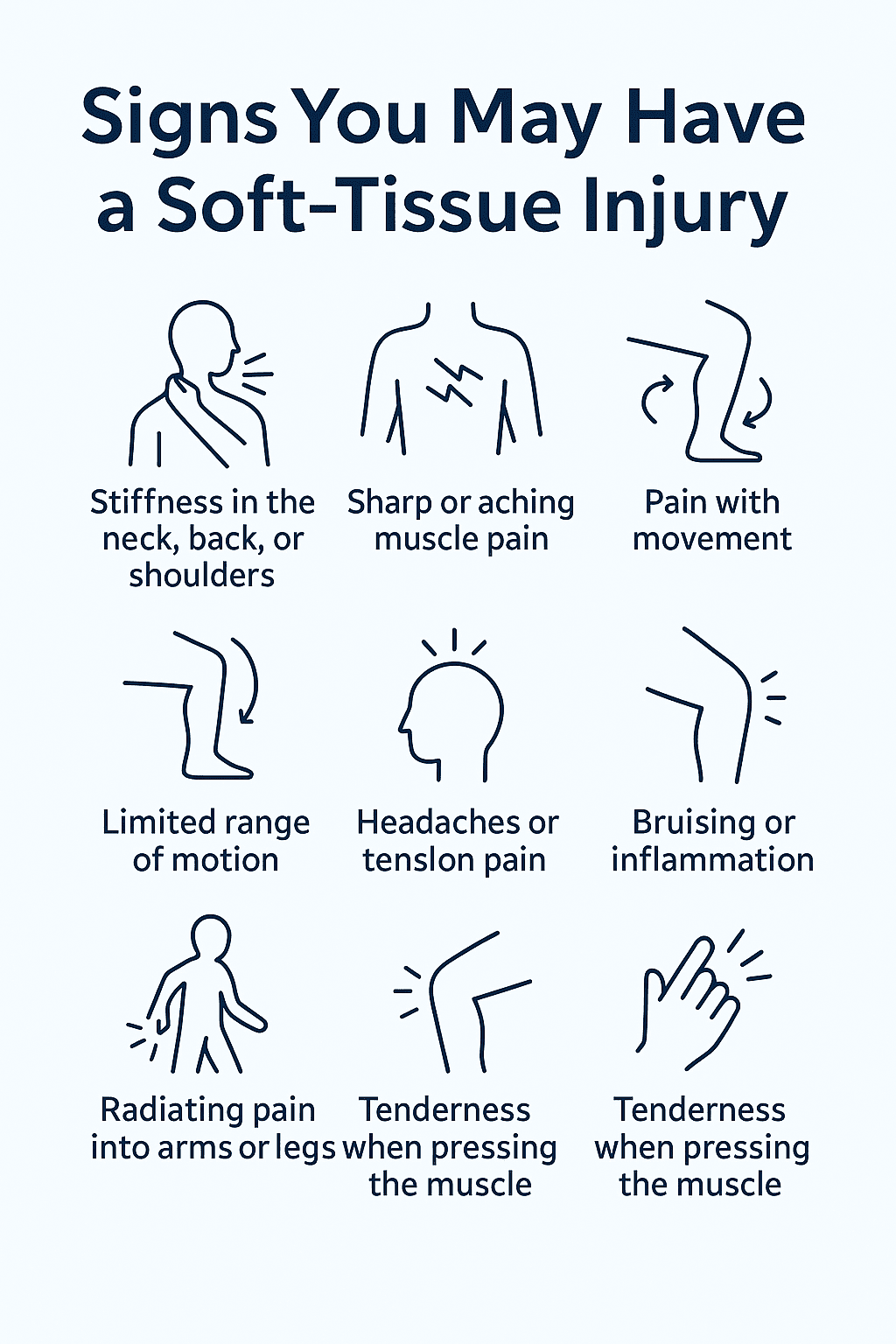
Soft-tissue injuries often appear hours to days after a collision.
Common symptoms include:
Stiffness in the neck, back, or shoulders
Sharp or aching muscle pain
Pain with movement
Limited range of motion
Headaches or tension pain
Bruising or inflammation
Radiating pain into arms or legs
Tenderness when pressing the muscle
If your pain is worsening instead of improving, you likely have a soft-tissue injury that needs targeted care.

How We Treat Soft-Tissue Injuries After a Car Accident in Cedar Park
Every soft-tissue injury is different, so here at Car Accident Chiropractic we design your treatment plan around how your body was affected during the collision. We look at impact direction, crash speed, and where your muscles or ligaments were overstretched or torn to create a customized recovery plan.
-
Auto accidents can shift joints out of their normal alignment, creating nerve irritation, muscle tension, and restricted movement. Our gentle chiropractic adjustments restore proper alignment without forceful techniques that could aggravate injured tissues. By relieving pressure on the nerves and improving joint mobility, adjustments help reduce pain, increase range of motion, and support healthy function throughout the spine and extremities.
-
Soft-tissue therapy focuses on the muscles, ligaments, and fascia that are commonly damaged in auto accidents. During a collision, these tissues can overstretch, tear, or develop painful knots known as trigger points. Myofascial release gently breaks up scar tissue, reduces muscle tension, increases circulation, and restores normal movement patterns. This technique also helps calm protective muscle guarding, making it easier for your body to heal and respond to chiropractic adjustments.
-
Inflammation is the body’s natural response to injury, but after an auto accident it can become excessive and lead to pain, stiffness, and reduced mobility. We use targeted therapies to decrease swelling and calm irritated tissues. These methods support early-stage healing, reduce pain, improve comfort, and prevent minor injuries from turning into long-term chronic issues. Lowering inflammation also accelerates the recovery process and prepares the tissue for more active treatment.
-
Instrument-assisted therapies use specialized tools to treat damaged soft tissue more precisely than hands alone. These techniques help break down adhesions, improve blood flow, stimulate healing, and relieve muscle tightness caused by impact forces. Many patients find these treatments especially helpful for stubborn tension, chronic knots, and deeper soft-tissue injuries that aren’t resolving with massage alone.
-
For patients experiencing disc pressure, nerve irritation, or radiating pain into the arms or legs, spinal decompression can be extremely effective. This gentle traction therapy creates space between the vertebrae, reduces disc bulging, and allows irritated nerves to calm down. Decompression is especially helpful following auto accidents because sudden impact forces often affect the discs and surrounding soft tissue.
-
As your pain decreases and tissues begin to heal, corrective exercises are essential for rebuilding strength, stability, and healthy movement patterns. Rehab helps prevent reinjury, improves posture, increases flexibility, and restores proper function to injured muscles and joints. These exercises are customized to your specific injuries and are progressed safely based on how your body responds to treatment.
Do Soft-Tissue Injuries Heal on Their Own?
Not always. Research shows that many soft-tissue injuries—such as muscle strains, ligament sprains, and whiplash-related trauma—often do not fully heal without proper treatment, especially when caused by the sudden forces of an auto accident.
Studies on whiplash and post-collision soft-tissue injuries consistently find that a significant percentage of patients continue experiencing symptoms months to years after the crash when injuries are not properly treated early on.¹ ²
Many patients with untreated soft-tissue damage report ongoing pain, stiffness, reduced mobility, and flare-ups 6–12 months after the accident, which can become chronic if the tissues heal incorrectly.
$0 Out-of-Pocket for Auto Injury & Soft-Tissue Injury Pain Patients
Most patients with soft-tissue injuries from a car accident in Cedar Park pay $0 out-of-pocket for their chiropractic evaluation, treatment, and medical documentation. Whether your muscle or ligament pain started immediately or showed up days after the collision, your care is typically covered through auto insurance, Med-Pay, or an attorney lien.
After an accident, insurance companies require accurate documentation of your soft-tissue injuries to show that your pain and mobility issues are directly related to the crash. That’s why early evaluation is so important—your visit not only helps the injured tissues heal properly, it also protects your claim and ensures that your care is covered.
At Car Accident Chiropractic, we work directly with:
Auto insurance claims (at-fault and not-at-fault when applicable)
Attorney liens / Letters of Protection (LOP)
Med-Pay / Personal Injury Protection (PIP)
Uninsured and underinsured motorist coverage
Our team guides you through every step—verifying your claim, reviewing your coverage, and coordinating with your attorney when needed. You’ll always know what’s covered, what to expect, and what your options are before any treatment begins.
For most patients, this means no upfront costs, no surprise bills, and no obstacles to getting the soft-tissue injury care you need.
How Do You Know If Your Soft-Tissue Injury Is More Serious?
Many patients assume their post-accident soreness is “just bruised muscles,” but true soft-tissue injuries often involve much deeper structures that don’t heal well without proper care. Even a low-speed collision can overstretch ligaments, tear muscle fibers, inflame fascia, or irritate the tissues that stabilize your spine and joints. This is why symptoms may start mild but worsen over 24–72 hours as inflammation builds and deeper tissue damage becomes more noticeable. A soft-tissue injury can include:
🔹 Muscle Strains & Microtears
The rapid acceleration–deceleration of a crash can overstretch or tear muscle fibers. This leads to sharp pain with movement, spasms, weakness, or deep aching that doesn’t improve with rest alone. These injuries are extremely common in rear-end collisions and can take weeks to heal without proper treatment.
🔹 Ligament Sprains
Ligaments stabilize your joints, and when overstretched, they can take 8–12 weeks or longer to heal. Sprained ligaments are a major cause of chronic post-accident pain because stretched ligaments create joint instability, which leads to recurring flare-ups, stiffness, and muscle compensation patterns.
🔹 Fascial Restriction & Myofascial Pain
Fascia is the connective tissue that surrounds your muscles. After a collision, it can become tight, inflamed, or develop painful trigger points. This often leads to tension headaches, shoulder tightness, or a “pulling” sensation in the neck, mid-back, or lower back. Myofascial pain rarely resolves on its own and responds best to hands-on soft-tissue therapy.
🔹 Joint Capsule Strain
The capsules surrounding your spinal and extremity joints can stretch during impact. This may cause sharp pain with bending or twisting, clicking sensations, or stiffness that lasts weeks or months if untreated. Capsule injuries are especially common in rear-end and side-impact collisions where the body is suddenly forced in multiple directions.
🔹 Nerve Irritation From Soft-Tissue Swelling
Inflamed soft tissues can put pressure on nearby nerves, causing radiating pain, numbness, tingling, or weakness. This is common in cases of whiplash, shoulder strain, or lower back soft-tissue injury. Without proper care, nerve irritation can become chronic and affect mobility long-term.
When to Get Checked for a Soft-Tissue Injury
If your soft-tissue symptoms:
have lasted more than 24 hours,
are getting worse instead of improving,
or include stiffness, swelling, sharp pain, radiating discomfort, numbness, or limited movement…
…then it’s important to be evaluated by an auto-injury chiropractor in Cedar Park or Leander. Early treatment helps prevent chronic inflammation, scar-tissue buildup, instability, and long-term pain.
If you’ve been searching for “soft tissue injury treatment after a car accident near me,” this is your sign — it’s time to schedule an exam.
Additional Injuries We Treat After a Motor Vehicle Accident





-
![Chiropractor in Cedar Park providing spinal adjustments for pain relief]()
Jackie G.
“I had never had any pain or prior issues until the accident & was struggling with movement in my neck from the whiplash and over the past few months, I’ve been able to regain all motion with no issues or pain! I would definitely recommend their services since the staff there is always so nice & attentive, and Dr. Melot is an educated, kind and proactive professional who cares about his clients and his work. Whether you’re in need of a simple adjustment, or months of recovery, you get the proper maintenance and help you deserve. Thanks again for all your help and patience, Dr. Melot!” -
![Local chiropractor near Hwy 183 offering same-day appointments]()
Ashlyn V.
“Dr. Melot has helped me recover from my car accident and truly cares about his patients and values a natural holistic approach!” -
![Affordable family chiropractor conveniently located near Cedar Park High School]()
Andrea G.
“Dr. Melot and his entire staff is highly recommended!! The level of customer care and compassion is outstanding. I always leave feeling better physically and mentally. They ensure I am knowledgeable about my health and well-being. Initially, I needed to see them due to a car accident but I am sure I will continue to see them for the continued health benefits I have been receiving so far!” -
![Whiplash and pain relief treatment by Cedar Park chiropractor]()
Lillian R.
“I’ve been coming here for a few months after I had a pretty bad automobile accident. Dr Melot spent a lot of time with me on the first visit and each adjustment since has helped so much. Naymar has been giving me massages every week as well and she is the best massage therapist I’ve ever had in my life. She’s extremely knowledgeable of the body, and she’s focused on helping you to work with your body to heal from the trauma. She’s so kind and loving and adjusts according to what your body needs that day. Couldn’t recommend more, she’s an absolute gem.” -
![Patient receiving back adjustment from Cedar Park chiropractor for lower back pain]()
Bianca H.
“I’ve been seeing Dr. Melot for a motor vehicle accident I was in and I can’t thank them enough for the amazing care I have received! The whole team is wonderful and I don’t think my recovery would be what it is without them. Thank you so much!!” -
![Car accident chiropractor in Cedar Park offering whiplash treatment]()
Sabella O.
"Went to another place before here and they didn’t do what was asked, came here and felt heard and felt amazing after! Definitely recommend!!"

Why Cedar Park Patients Trust Us for Soft-Tissue Injury Care


Dr. Melot Has Experienced Soft-Tissue Injuries
In 2022, Dr. Melot and his family survived a 70-mph head-on collision — an experience that left him dealing with the same delayed soreness, hidden soft-tissue injuries, and uncertainty that many Cedar Park patients feel after a car accident. That firsthand recovery journey shaped the way he cares for every injury patient today. He now delivers a higher level of precision, empathy, and attention because he’s lived it himself.
Patients receive:
$0 out-of-pocket care for most auto-injury soft-tissue cases
Detailed medical documentation attorneys and insurers rely on
Gentle, injury-specific chiropractic treatments for sensitive soft tissues
Customized rehab plans that support long-term healing and stability
Same-day appointments and walk-ins for urgent post-accident evaluations
Choosing Car Accident Chiropractic after an auto accident means receiving specialized soft-tissue injury care, precise medical documentation, and effective treatment for the hidden or delayed injuries that so many patients experience. We focus on accurately diagnosing and treating muscle strains, ligament sprains, whiplash-related trauma, neck and back soft-tissue injuries, headaches, nerve irritation, and other post-collision conditions that many clinics overlook.
Most auto-injury patients pay $0 out-of-pocket, and our team provides the detailed exam notes, injury documentation, and treatment plans that attorneys and insurance companies rely on. With gentle chiropractic adjustments, digital X-ray referrals when needed, and personalized soft-tissue rehabilitation, we help you heal faster, prevent chronic pain, and support the integrity of your claim.
If you’re searching for soft-tissue injury treatment after a car accident in Cedar Park or Leander, we’re here to guide your recovery from day one.
“I don’t just treat whiplash and auto injuries — I’ve personally experienced the pain and recovery.”
Get Checked Before Your Soft Tissue Pain Gets Worse
🔸Same Day Appointments 🔸Walk-In Appointments🔸$0 Out-of-Pocket 🔸Soft Tissue Injury Specialists