

Concussion Symptoms After a Car Accident in Cedar Park
Headaches • Dizziness • Foggy Thinking • Sensitivity to Light | $0 Out-of-Pocket Care
You don’t need to hit your head to get a concussion during a car accident. Sudden acceleration–deceleration forces can cause the brain to shift inside the skull, leading to headaches, dizziness, fogginess, vision changes, and concentration problems. If these symptoms have appeared hours or days after your crash, you may be experiencing post-concussion symptoms, even if your ER exam or X-ray was “normal.”
At our clinic, we provide specialized concussion evaluation and treatment after a car accident in Cedar Park, often with $0 out-of-pocket.
What Is a Post-Accident Concussion?
Understanding Why Concussions Are Common After Car Crashes
A concussion is a mild traumatic brain injury (mTBI) caused by rapid movement of the brain inside the skull. During a collision, your head and neck can snap forward and backward—even without hitting anything—causing neurological changes that affect how the brain processes information.
Common causes during auto accidents include:
Whiplash forces
Sudden deceleration
Side-impact rotation
Airbag deployment
Seat belt restraint forces
These neurological changes may not show up on standard imaging like CT scans or X-rays, which is why symptoms can go overlooked.
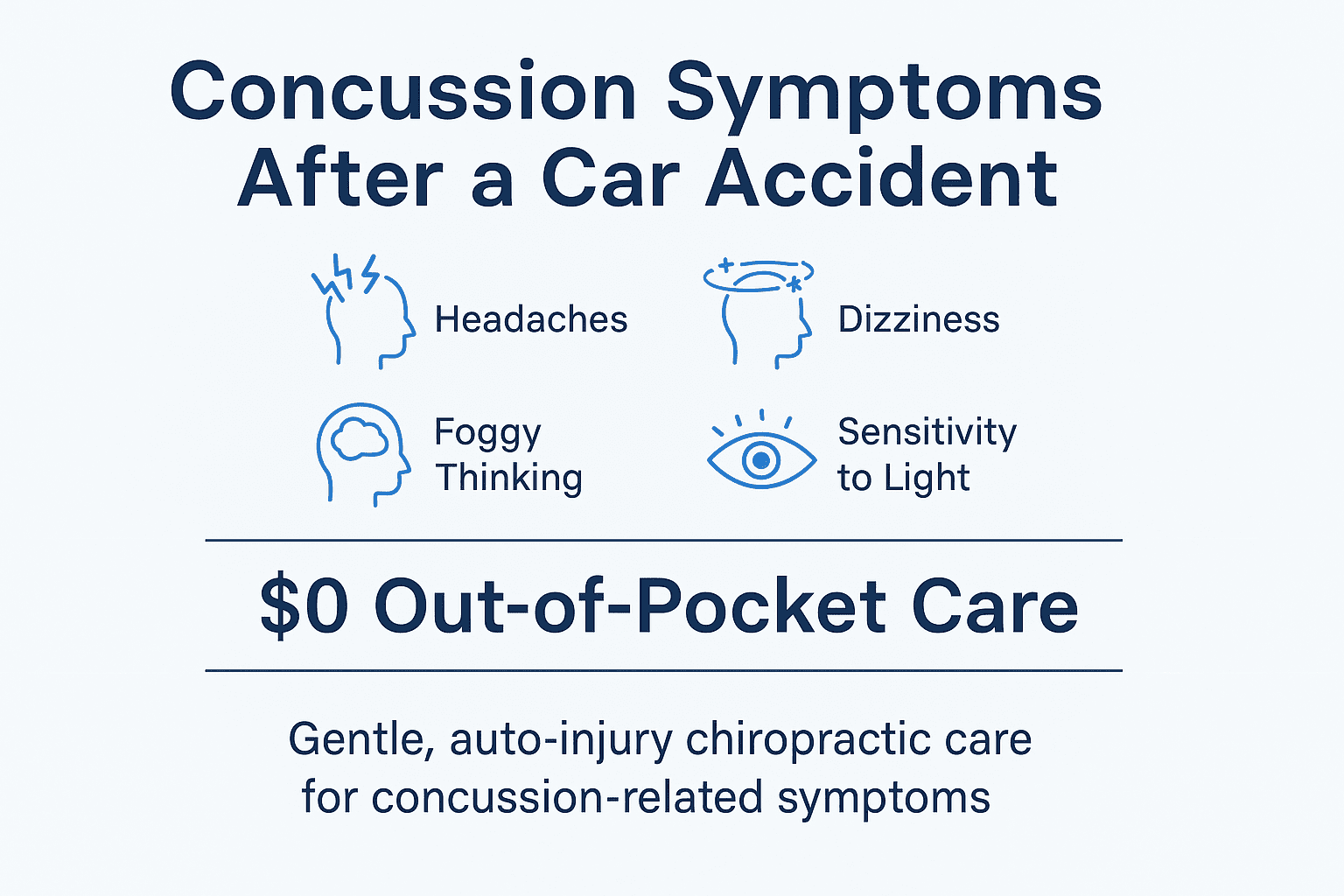
Common Concussion Symptoms After a Car Accident
Concussions symptoms often appear hours to days after a collision.
Common signs include:
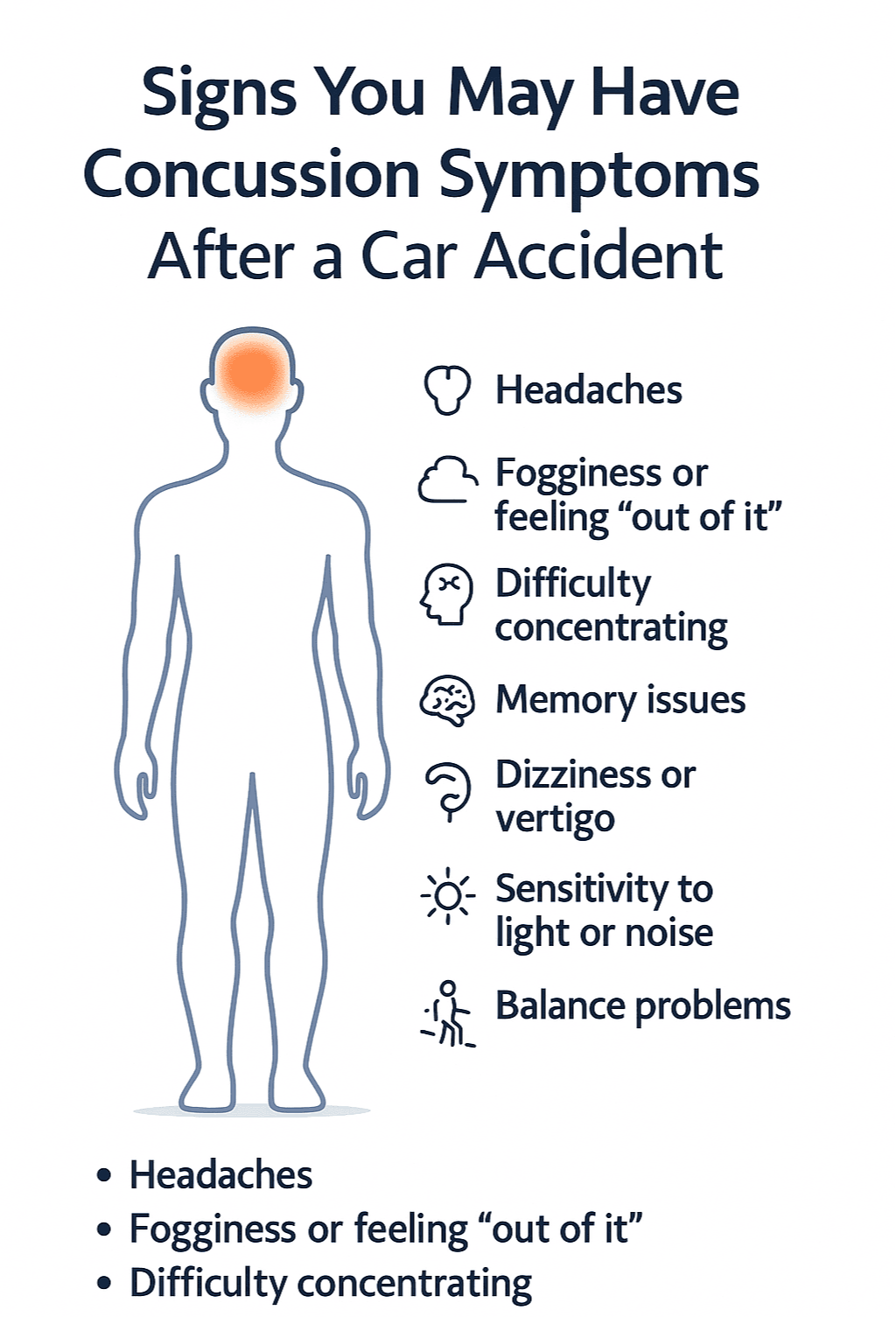
Physical Symptoms
Headaches
Dizziness or vertigo
Nausea
Sensitivity to light or noise
Blurred or double vision
Balance problems
Emotional / Sleep Symptoms
Irritability
Anxiety
Trouble sleeping
Feeling unusually tired
Cognitive Symptoms
Fogginess or feeling “out of it”
Difficulty concentrating
Memory issues
Slow thinking or delayed responses
Why Concussions Are Often Missed in the ER
Most patients are told their scans are “normal,” but concussions rarely show up on imaging. ER visits typically rule out life-threatening issues, not soft-tissue or neurological complications from whiplash.
Undiagnosed or untreated concussion symptoms may lead to:
Chronic headaches
Persistent dizziness
Vision problems
Concentration issues
Neck stiffness
Long-term cognitive symptoms
Early evaluation helps identify these issues before they become long-standing problems because symptoms often develop gradually and can worsen without proper care.

How We Treat Concussion Symptoms After a Car Accident in Cedar Park
Each concussion presents differently, so we create a treatment plan based on your specific symptoms and the mechanics of your crash. We evaluate how the impact affected your head and neck, which neurological functions were disrupted, and how the whiplash forces may be contributing to headaches, dizziness, or fogginess. This ensures highly targeted concussion care and a safer, faster recovery.
-
When the head snaps forward and backward during a collision, the upper neck muscles and joints often become strained or misaligned. This cervical tension can restrict normal nerve flow and worsen concussion symptoms such as headaches, dizziness, and brain fog.
Gentle chiropractic adjustments help restore proper motion to the upper cervical spine, reduce inflammation, and calm irritated nerves. This improves blood flow, decreases pressure on the brainstem region, and allows the neurological system to function more efficiently.
For many patients, relieving cervical tension is one of the fastest ways to reduce post-concussion headaches and improve clarity and focus.
-
Soft-tissue injuries in the neck and upper back often occur alongside concussions, especially when whiplash forces are involved. Tight muscles can restrict movement, pull on the base of the skull, and contribute to headaches, pressure, and difficulty concentrating.
Soft-tissue therapy targets these restricted areas to reduce muscle guarding, improve circulation, release trigger points, and restore normal movement patterns. Relaxing the neck and upper-back muscles can significantly reduce post-concussion discomfort and support better neurological healing.
-
The vestibular system—located in the inner ear—controls balance, spatial awareness, and coordination. Even mild concussions can disrupt this system, leading to dizziness, unsteadiness, or a “floating” feeling.
Vestibular rehabilitation includes targeted exercises that retrain balance pathways, improve coordination, and help the brain reinterpret motion signals correctly. These exercises are especially beneficial for patients who feel dizzy when turning their head, walking in busy environments, or riding in a car.
-
Concussions commonly affect how the eyes work together. Patients may experience blurred vision, difficulty focusing, light sensitivity, or trouble with screen use.
Oculomotor exercises strengthen the eye muscles and improve visual coordination, tracking ability, and focus. These activities help the visual and neurological systems communicate more clearly, reducing headaches, motion sensitivity, and fatigue caused by poor eye movement control.
This training is essential for patients who notice increased symptoms when reading, scrolling on their phone, or riding in a moving vehicle.
-
Neurological rehabilitation supports the areas of the brain affected by the concussion. These targeted activities help restore brain-body communication, improve processing speed, and strengthen cognitive function.
Exercises may include coordination drills, sensory integration tasks, reflex work, or cross-body movements that encourage healthy neural pathways. This type of therapy can improve clarity, reduce brain fog, and enhance overall cognitive performance after a crash.
-
Healing from a concussion continues beyond the treatment room. Your personalized home care plan may include light exercises, screen-time guidelines, pacing strategies, sleep recommendations, and sensory rest techniques to support neurological recovery.
These tools help you avoid symptom flare-ups, reduce overstimulation, and steadily progress through the healing process. Your plan evolves as your symptoms improve, ensuring you recover safely and effectively.
Do Post-Accident Concussion Symptoms Resolve on Their Own?
Not always. The sudden acceleration–deceleration forces during a car accident can disrupt normal brain function, leading to concussion symptoms such as headaches, dizziness, fogginess, vision changes, and difficulty concentrating. While some symptoms may seem mild at first, they often do not fully resolve on their own without proper evaluation and care. Symptoms may even worsen over the first 24–72 hours as the brain responds to the trauma.
Research on post-concussion injuries shows that many patients continue experiencing symptoms for months or even years when concussions are not identified and treated early. This may include persistent headaches, light sensitivity, balance issues, mental fatigue, and difficulty focusing or remembering information.
Many patients with untreated concussion symptoms report ongoing fogginess, dizziness, sleep disturbances, and cognitive challenges 6–12 months after the accident. Without appropriate care, these symptoms can become chronic and significantly affect daily functioning.
$0 Out-of-Pocket Care for Auto-Injury Concussion Symptoms
Most patients with concussion symptoms after a car accident in Cedar Park pay $0 out-of-pocket for their neurological evaluation, treatment, and medical documentation. Whether your symptoms—such as headaches, dizziness, fogginess, or vision changes—started immediately or appeared days after the collision, your care is typically covered through auto insurance, Med-Pay, or an attorney lien.
After an accident, insurance companies require clear and accurate documentation of your concussion-related symptoms to show that your neurological changes are directly connected to the crash. That’s why early evaluation is so important—your visit not only helps you recover faster and more safely, it also protects your claim and ensures that your treatment is properly covered.
At Car Accident Chiropractic, we work directly with:
Auto insurance claims (at-fault and not-at-fault when applicable)
Attorney liens / Letters of Protection (LOP)
Med-Pay / Personal Injury Protection (PIP)
Uninsured and underinsured motorist coverage
Our team guides you through every step—verifying your claim, reviewing your coverage, and coordinating with your attorney if needed. You’ll always know what’s covered, what to expect, and what your options are before any concussion-related treatment begins.
For most patients, this means no upfront costs, no surprise bills, and no barriers to getting the concussion symptom care you need.
How Do You Know If Your Concussion Symptoms Are More Serious?
Many patients assume their post-accident fogginess or headaches are “just stress,” but true concussion symptoms often involve deeper neurological changes that do not heal well without proper care. Even a low-speed collision can cause the brain to shift inside the skull, disrupt normal nerve signaling, or strain the upper neck structures that directly influence balance, vision, and cognitive function. This is why concussion symptoms may start mild but worsen over 24–72 hours as inflammation increases and the brain attempts to recalibrate.
A concussion after a car accident can include:
🔹 Headaches & Pressure Sensations
The rapid acceleration–deceleration forces of a crash can cause the brain to shift, leading to persistent headaches or a feeling of pressure inside the skull. These headaches often worsen with screen time, bright lights, or physical activity and do not improve with rest alone.
🔹 Cognitive Changes (Brain Fog & Slow Thinking)
Concussions frequently affect the brain’s ability to process information efficiently. Patients may feel foggy, mentally slowed, forgetful, or easily overwhelmed. These symptoms can last weeks or months without targeted neurological rehabilitation.
🔹 Dizziness, Vertigo & Balance Problems
Impact forces can disrupt the vestibular system in the inner ear, which is responsible for balance and spatial awareness. This leads to dizziness, motion sensitivity, difficulty walking in busy environments, or a “floating” sensation. Vestibular issues rarely resolve fully without guided exercises.
🔹 Vision Problems & Eye-Movement Dysfunction
Concussions commonly affect how the eyes work together. Patients may notice blurred vision, trouble focusing, sensitivity to light, or discomfort when reading or scrolling. These symptoms point to oculomotor (eye-movement) dysfunction, which requires specific retraining—not just rest.
🔹 Neck Strain That Worsens Concussion Symptoms
Whiplash and cervical strain often occur alongside concussions. Irritated neck muscles and joints can contribute to headaches, dizziness, and difficulty concentrating. Treating cervical dysfunction is a key part of reducing concussion symptoms.
🔹 Emotional & Sleep Disturbances
Concussion-related neurological changes can affect mood and sleep patterns. Patients may feel more irritable, anxious, fatigued, or have trouble falling or staying asleep. These symptoms indicate deeper involvement in brain regulation systems.
When to Get Checked for a Soft-Tissue Injury
If your soft-tissue symptoms:
have lasted more than 24 hours,
are getting worse instead of improving,
or include stiffness, swelling, sharp pain, radiating discomfort, numbness, or limited movement…
…then it’s important to be evaluated by an auto-injury chiropractor in Cedar Park or Leander. Early treatment helps prevent chronic inflammation, scar-tissue buildup, instability, and long-term pain.
If you’ve been searching for “soft tissue injury treatment after a car accident near me,” this is your sign — it’s time to schedule an exam.
Why Cedar Park Patients Trust Our Concussion Symptom Care After a Car Accident


Dr. Melot Understands Your Concussion Symptom Injuries
In 2022, Dr. Melot and his family survived a 70-mph head-on collision — an experience that left him facing the same head pressure, dizziness, fogginess, headaches, and delayed concussion symptoms that many Cedar Park patients experience after a car accident. Going through that recovery himself reshaped the way he evaluates and cares for every injury patient today. He now delivers a higher level of precision, empathy, and attention because he understands firsthand how frightening and confusing post-concussion symptoms can be. Patients receive:
$0 out-of-pocket care for most auto-injury concussion and soft-tissue cases
Accurate medical documentation that attorneys and insurance companies depend on
Gentle, injury-specific chiropractic and neurological assessment appropriate for concussion symptoms
Customized recovery and rehab plans that support brain rest, cervical healing, and long-term stability
Same-day appointments and walk-ins for urgent post-accident concussion evaluations
Choosing Car Accident Chiropractic after a collision means receiving specialized care for post-concussion symptoms, precise medical documentation, and focused treatment for the hidden or delayed injuries that often follow an auto accident. We accurately evaluate and address issues such as headaches, dizziness, fogginess, sensitivity to light or sound, neck instability, whiplash-related trauma, and cervical soft-tissue injuries — all of which commonly contribute to or worsen concussion symptoms. Many clinics overlook these subtle but important findings; we don’t.
Most auto-injury patients pay $0 out-of-pocket, and our team provides the detailed exam notes, concussion-related documentation, and treatment plans that attorneys and insurance companies rely on. With gentle chiropractic care, cervical stabilizing techniques, digital imaging referrals when necessary, and personalized rehabilitation designed to support neurological recovery, we help you heal faster, reduce symptoms, and prevent long-term complications.
If you’re searching for concussion symptom care after a car accident in Cedar Park or Leander, we’re here to guide your recovery from day one.
“I don’t just treat whiplash and auto injuries — I’ve personally experienced the pain and recovery.”
-
![Chiropractor in Cedar Park providing spinal adjustments for pain relief]()
Jackie G.
“I had never had any pain or prior issues until the accident & was struggling with movement in my neck from the whiplash and over the past few months, I’ve been able to regain all motion with no issues or pain! I would definitely recommend their services since the staff there is always so nice & attentive, and Dr. Melot is an educated, kind and proactive professional who cares about his clients and his work. Whether you’re in need of a simple adjustment, or months of recovery, you get the proper maintenance and help you deserve. Thanks again for all your help and patience, Dr. Melot!” -
![Local chiropractor near Hwy 183 offering same-day appointments]()
Ashlyn V.
“Dr. Melot has helped me recover from my car accident and truly cares about his patients and values a natural holistic approach!” -
![Affordable family chiropractor conveniently located near Cedar Park High School]()
Andrea G.
“Dr. Melot and his entire staff is highly recommended!! The level of customer care and compassion is outstanding. I always leave feeling better physically and mentally. They ensure I am knowledgeable about my health and well-being. Initially, I needed to see them due to a car accident but I am sure I will continue to see them for the continued health benefits I have been receiving so far!” -
![Whiplash and pain relief treatment by Cedar Park chiropractor]()
Lillian R.
“I’ve been coming here for a few months after I had a pretty bad automobile accident. Dr Melot spent a lot of time with me on the first visit and each adjustment since has helped so much. Naymar has been giving me massages every week as well and she is the best massage therapist I’ve ever had in my life. She’s extremely knowledgeable of the body, and she’s focused on helping you to work with your body to heal from the trauma. She’s so kind and loving and adjusts according to what your body needs that day. Couldn’t recommend more, she’s an absolute gem.” -
![Patient receiving back adjustment from Cedar Park chiropractor for lower back pain]()
Bianca H.
“I’ve been seeing Dr. Melot for a motor vehicle accident I was in and I can’t thank them enough for the amazing care I have received! The whole team is wonderful and I don’t think my recovery would be what it is without them. Thank you so much!!” -
![Car accident chiropractor in Cedar Park offering whiplash treatment]()
Sabella O.
"Went to another place before here and they didn’t do what was asked, came here and felt heard and felt amazing after! Definitely recommend!!"

Additional Injuries We Treat After a Motor Vehicle Accident









Don’t Wait — Get Evaluated Before
Your Concussion Symptoms Intensify
🔸Same Day Appointments 🔸Walk-In Appointments🔸$0 Out-of-Pocket 🔸Concussion Symptom Specialists